
What Oatmeal Pancakes Can Teach Us About Saving and Investing?
By Brian Aberle, August 2026
On August 15th, 2026, I completed what was, for me, the craziest challenge over my now five decades on this planet. I successfully finished the Leadville 100 Mountain Bike Race, a grueling race in the mountains surrounding Leadville, Colorado (hence the name), with the course entirely between 9,300 and 12,500 feet in elevation. I finished in around 10 1/2 hours, earning me the coveted "finisher" homemade belt buckle. The first 40 miles, including a tough initial climb, took me just ~3 hours. The last 60 miles took me 7 1/2 hours, after I was nearly broken with debilitating cramps. More on this further down.
The reason for the race was deeply personal: primarily to honor the family members I've lost over the past several years and to challenge myself to "do something hard" as a way to move forward in life. I won't bore you with that whole story, as many clients may already know much of it, but if you wanted to read a local paper's story on my "why", you can find it here. And if you're really bored, you can watch the full race broadcast replay (of the pros) on YouTube here. If anything, it's a heck of a marketing video for Leadville and Colorado in general. The scenery, helicopter and drone footage, and the Leadville community are amazing. To be part of it was gratifying.
I learned I was accepted into the race via lottery in early January of 2026 and had eight months to build some semblance of fitness, endurance, and a fueling strategy (a big part of the race) that would get me from my normal 5- to 10-mile (if I'm lucky) ride lengths to something 10 to 20 times that load. I worked with two coaches, one on the fitness and fuel side who set up daily strength and riding sessions, and one on the nutrition side, both of whom helped keep me accountable when I fell off the wagon (more than a few times).
Over the eight months, I also had to train my gut to replenish some of the 6,000+ calories I was expected to expend. I had to fid absorb 400 calories and 100+ grams of carbohydrates, plus 100s of mg of extra salt, per hour, without somehow getting sick. I didn't know this was a thing, but I assure you that exercise-induced GI distress is very real. I thought I had it figured out, but race day was a totally different animal. The cramps turned out to be evidence that I hadn't done quite enough in this critical training. At mile 70, I could not eat or drink anything without full-on rejection. I limped to the finish line, barely able to turn over the pedals. But I did it. I couldn't eat until the next afternoon, not even the celebratory beer.
Oatmeal Pancakes and Training (the Gut)
I'm convinced there is a small percentage of the population that wakes up every day craving oatmeal. I was never one of those people. After all, there is a reason that when you go to a hotel's complimentary breakfast, the hot oatmeal container is nearly full. Only when everything else has been devoured does someone seem to touch the container.
For those not accustomed to eating oatmeal regularly, the magic trick it plays on the digestive system can be quite something when heading to a long meeting or, worse, boarding a plane for a 4+ hour flight. And it's not something you want to try the morning of a 10+ hour mountain bike race, unless as a tactic to create physical space from your competitors, which, if so, my tip of the cap.
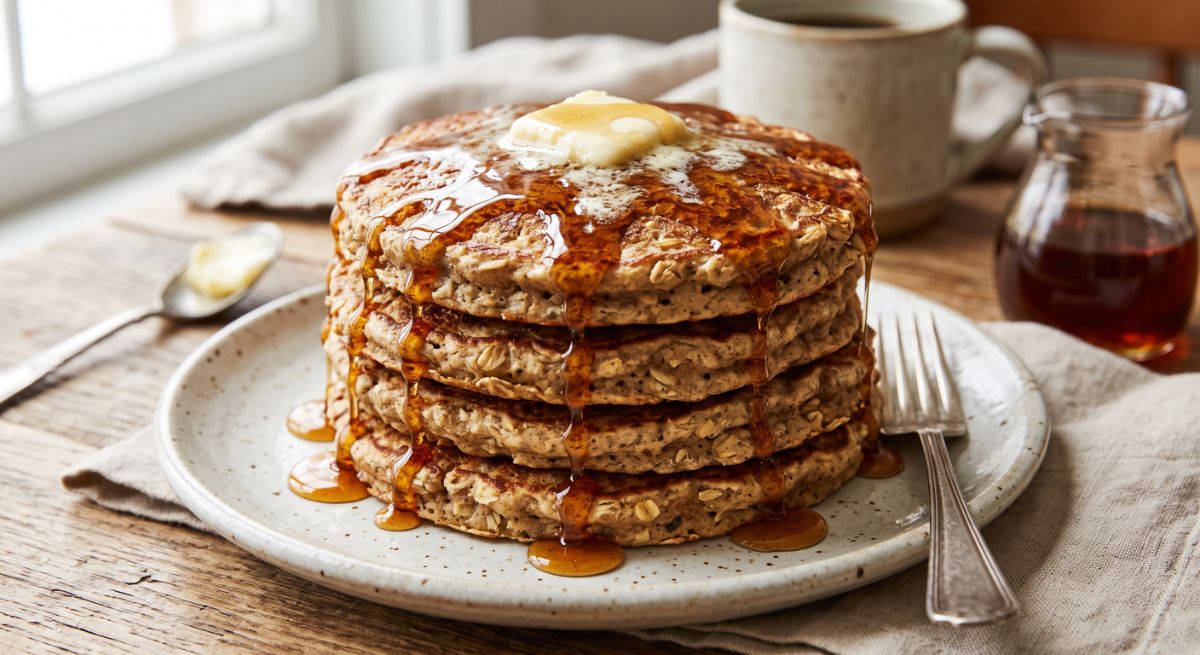
As I was training for my race, early on, I couldn't seem to figure out breakfast and pre-ride nutrition, sans excessive coffee consumption for early AM rides. Protein did nothing other than gum me up. Greens and smoothies left me hungry an hour later. Yet in our pantry sat steel-cut oats we'd likely bought two years earlier, at a moment of nutritional guilt while grocery shopping. Their moment in the sun had finally arrived.
I decided to make oatmeal pancakes.
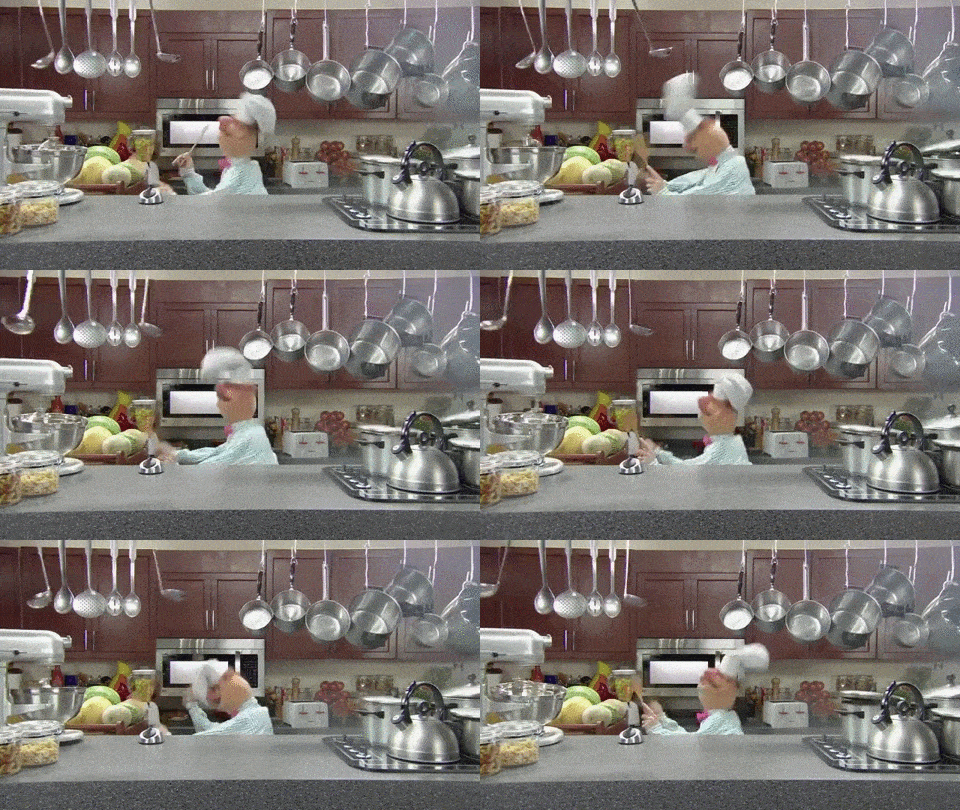
Now, if you've ever been so unlucky as to watch me try to cook with dry goods like flour, or bake anything (like cookies), it's a bit of a horror show, something like the Muppet's Swedish chef mixed with the artist Jackson Pollock. Somehow, just a few ingredients often manage to find their way onto every surface, into every drawer, and onto every utensil. All that's missing from the powdered goods crime scene is a silhouette of where they found the body.
Turns out, after I cleaned up, the pancakes weren't half bad. I wolfed them down, and true to form, I was reminded that I had wolfed them down about an hour later while on my mountain bike ride. The belly just wasn't enjoying the change in routine. But at least I wasn't hungry, and I had plenty of gas (ahem) in the tank to keep riding.
The next day, I made oatmeal pancakes again. Maybe a little less messy this time. And, the day after that, and the day after that. The longer I went, the more I upped the ante on oats vs bonding (flour). The more comfortable the belly got, the longer the rides got. I ate pancakes for breakfast perhaps 6 days a week for seven months. I still struggle to do just plain ol' oatmeal, however.
Now that the race is in the rearview, I'm still crushing them darn near every day because the body is used to it, and, well, they work pretty well for me now. And, being somewhat thrifty, I can eat pancakes for a month for less than my Gen Z friends will spend on a single avocado toast at the coffee shop. It's avocado... on toast, people. It shouldn't cost $13. Just stop it.
The "Oatmeal" Mental Trap
Every industry sees a biased solution to a problem. A realtor thinks about real estate constantly. A lawyer thinks about law. We finance folks naturally think about money, not necessarily how to accumulate more (though plenty do), but about ways to be better at the game of money. A tax professional thinks about… well, they (and maybe dentists) wonder about why they chose their profession in the first place. I digress, and just kidding, tax professionals - sort of.
As I was training and gradually getting into my eating rhythm, I, like all other normal people, naturally thought about how diet and exercise both benefit from compounding. You know... just like investing and saving. Right?
Ok, I didn't actually think this at the time. But there is a lot of truth to it when we stop to think about it. Allow me to explain, sticking with health for a little while longer. I was curious as to why good intentions tend to break. Why do routines not stick? Why did my friends who offered to co-train with me flame out after a ride or two?
There are many reasons, but it generally comes down to behavior. For this part, I leaned on my valued research assistant (Google Gemini AI) to provide a bit more context. Here's what it told me (bold italics), along with my interpretations.
🏋️ The "Too Much, Too Soon" Trap - Crushing too much Oatmeal, Going Too Hard at the Gym
Any time we shock our habits, challenging outcomes are bound to happen, such as:
Energy depletion: Going from sedentary to suddenly working out six days a week rapidly drains your willpower reserves.
Injury and soreness: Sudden intensity can cause severe muscle soreness (DOMS) or injury, triggering the brain's pain-avoidance mechanism.
Lifestyle shock: Drastic changes disrupt established daily routines, creating immediate friction.
Every year, generally around January first, the local gyms are crammed with new members. Some even dust off the space-walk-looking "sweat" suits they last wore 20 years ago, when said suits were just as dumb an idea. They smash the treadmills and the free weights for about a week, and then they vanish into the ether, not to return for another 346 days. At the same time, the health food aisles of the local grocery store are busier than they will ever be for the next twelve months, as shoppers are convinced "this is the year" they improve their eating, i.e, us and our bulk oatmeal purchase. I was (still am) this person. I'm generally rock-solid in my discipline until about January 15th; then the wheels come off the tracks.
How does this correlate to money? Unless you have always been a chronic saver, the idea of cutting back on spending, or telling your higher-socioeconomic or spendy friends that no, you cannot join them for drinks and steaks tonight, that you are trying to create better money habits, creates a rift. A harsh closing off can really mess up relationships. Hitting the gym vs hitting the bars. Too much sacrifice, too soon.
You can only invest if you have fewer expenses than income to begin with, but going "whole hog," as I so often heard growing up in the Midwest, sounds great with the investing, but over my 30 years as a financial advisor and planner, this mindset also tends to flame out quickly for so many; the sweatsuit example.
My trainer, Erinn, started me out relatively easily. We did an FTP fitness test to determine my baseline (not great). From there, we made incremental strides with some bigger pushes. We could take the FTP test at intervals. For a while, there was little change. But then, the compounding began, and the number ramped up substantially.
If I were to sit down with someone looking to start saving and investing, my first bit of advice would be to start just like I did with exercise: choose an amount they can afford to set up automatically, without fail. Get used to the routine. Automation may be the most important part of the equation, more so than the amount, as it builds consistency and training.
401ks s are designed for automation, but many major custodians like Schwab, Vanguard, Fidelity, and others offer investment plans where someone can literally start an account with $1 and make $25/month contributions to low-cost, no-load mutual funds or commission-free ETFs. It's the $25/month that is the building block. It's the habit, the eating of pancakes daily rather than 1x/week. In time, $25 becomes $50, then $100, then maybe $ 1,000, then a 4% to 8% contribution to a 401(k).
🧠 The False Hope Syndrome
Unrealistic expectations: Coined by psychologists, this describes the cycle of setting hyper-ambitious goals, feeling an initial surge of control, and then collapsing when rewards do not happen instantly.
Overestimating speed: People expect rapid physical transformation, which leads to frustration when changes take weeks to appear.
I went from maybe averaging 8-mile mountain bike rides to deciding to complete a 104-mile ride in just eight months. There are aggressive goals. And then there are "have you lost your mind?!" goals. This was one of those goals. I likely would have never pursued it had I not lost my family members, and thus my driving force of doing something impossibly hard. I didn't set out to deal with my grief this way; it was just instinctive, yet it was exactly what I needed.
During training, I often pushed things too hard. My coach Erinn had to reel me back in all the time. Call it the "mom effect," but given my deep respect for her and her athletic accomplishments, I wanted to be seen as an overachiever in her eyes. What I ended up with instead was finding myself out of gas deep into a ride, not to mention the saddle sores and truly becoming the "butt" of jokes that still make my crew giggle a bit. Sidenote, if the folks at Chamoix Butt'r somehow see this communication, I'm still open to an endorsement deal.
The better solution for me would have been to follow my coach and stick to the plan. It took me some time, and a sore bum, to come to that realization. Incremental gains, consistency, and compounding of my base are what worked. A big effort once a week only left me worn out and unable to train for days.
In finance, False Hope Syndrome is everywhere, perhaps worse today than it's ever been, given online influencers, YouTube get-rich-quick videos, crypto bros, and now the AI boom investors touting how they went from zero to hero. Newer investors, maybe a little late to the current bull market party, feel like they, too, could be a YouTube example.
Maybe we older folks could look back at the dot.com era or housing bubble of 2004 to 2007 as historical proxies of false hope. Maybe we know someone who lost a home during the housing crisis. While snake oil salespeople have existed forever, the firehose of influence thanks to social media is arguably the worst it's ever been in human civilization. Nobody wants to hear from the dude who just kept their head down and worked on incremental gains. After all, hope and false expectations generate far more clicks. Hope is showing up at the starting line after two weeks of training.
⏳ Present Bias and Hyperbolic Discounting - YOLO and Old Stumpy
Immediate gratification: The human brain naturally overvalues immediate rewards (eating a donut now) over future rewards (being healthy in six months).
The delayed payoff: Fitness and diet require accepting immediate discomfort for a highly delayed, abstract benefit, which is a difficult trade-off for human neurobiology.
When I was training for the race, numerous folks told me to get rid of my 10-year-old mountain Specialized Stumpjumper bike, affectionately named "Old Stumpy," and invest in a state-of-the-art ultra-lightweight cross-country racing mountain bike that costs as much as an economy car. I bought Stumpy (state-of-the-art at the time) used in 2021, after someone with more financial freedom than I had at the time decided that their failure to reach their goals on the trail was the responsibility of their bike, not their legs and cardio.
I was told by others, "This race is maybe a once-in-a-lifetime opportunity. Why risk it with your old bike? After all, you only live once (YOLO).
I understood their point, but I refused. I decided my approach would be through training discipline, and not by trying to shed a few pounds on my ride. I only had to look in the mirror to know it wasn't the bike that needed to cut weight. In addition, I was hopeful that, as a dad, I could make it over the finish line with Old Stumpy, maybe as an example for my 13-year-old son, that it's okay not to have all the fancy stuff the cool kids have. I'm not sure this last part registered, but it was worth a try.
When I'm talking to a younger person or a new investor, I often see disappointment in their eyes when I tell them that if they save $600/month for the next 30 YEARS, at 8% returns (if lucky), they'll have $1 million. They don't want to hear that. They want that money and the experiences it can afford, now, compounding be darned.
YOLOing is cooler these days. As a result, new investors, or even older investors playing catch up, often take on too much risk or use too much leverage. Maybe these days they prefer online gambling, hoping to strike it big, with a 5-player parlay at ridiculous odds, only to realize that losses tend to be 100% of one's wager; the equivalent of crushing too much metaphorical oatmeal the day of the race. After all, if one cup is good for you, three cups can only be better, right? Doesn't work that way.
Having that $1 million in 30 years, or $2 million with higher savings rates, doesn't seem like all that fun to many. After all, by then we'll be "old". And how on earth are we supposed to YOLO the way beverage, car, and travel commercials and influencers want us to, if all we're doing is putting money away for the future? Of course, when the future arrives, those of us who did put away money hear "wow, you are so lucky" and have to bite our collective tongues to not go on a rant about the sacrifices we had made to get there. As my wife Audrey said to encourage me during my training, "You are not only training for the race, but you're putting years of cardio health in the bank for your future."
"If Only"
Over the years, when I've lost clients, I would say 80% of the time it was because growth expectations couldn't realistically be met. The "I could have done better if only" instinct is often high. And, in truth, they're not entirely wrong. In the world of finance, as in most places, the benefit of hindsight means there is always a stock, fund, or strategy that did better than the one we chose. Such Monday-morning quarterbacking is something I have naturally done for thirty years as an advisor. After all, it takes one to know one.
🚫 The "What-the-Hell" Effect
All-or-nothing thinking: Formally known as the counterregulatory eating cue, this happens when a minor slip-up causes total abandonment of the goal.
The spiral: If a person eats one cookie, they feel they ruined their diet, decide "what the hell," and eat the whole box, abandoning the program entirely.
Early in my training, I became regimented with my diet. I rotated between perhaps 3 different meal plans per week. It wasn't fun, and I quit early on it. Where I was maniacal, however, was my focus on eliminating all alcohol consumption and tortilla chips until after the race. I've never been a big alcohol drinker, but chips and salsa were the glass slippers to this Cinderella's foot. My sister Julie and I would always lament our chip addiction. It has been a lifelong struggle.
However, one night just a week before the race, we hosted some friends at our place. I relented with a beer and chips. I then thought, "What the heck, I'll have another." I explained, with a nervous laugh, that someone needs to take the chips home. Sadly, the party-sized bag was left behind and didn't survive until the next evening. I cannot confirm, but I suspect two pounds of corn sitting in one's gut is not high on the pre-race nutrition list. The rest of the week wasn't much better.
With investing, the "What-the-Hell" effect comes early and often. Contrary to the past decade + of relative comfort, markets don't always go up. A decline in markets can at times create a visceral response, like a "why did I even bother" emotion. Investors, either through unfortunate timing or all of the behaviors already mentioned, throw in the towel when they see two years' worth of gains disappear in just one month. I've seen it where investors, shocked by declines in their portfolio, sit out the markets for years, going forward convinced, or maybe silently wishing that the market will turn down again just to make them feel a little less "dumb".
I've done this too, and I'm the guy who gets paid for this. I've lost track of how many times I've thrown in the towel on an investment, calling myself more names than a high school bully, only to see it redeem itself and then some. But because I gave up, I was resistant to getting back in, not to feel dumb a second time.
Don't give up when you have the WTH moment.
📅 The Fresh Start Effect Illusion
Temporal landmarks: Dates like January 1st create a psychological clean slate, making people feel disconnected from their past, lazier selves. My first start has always been around my birthday in October.
Motivation fading: This creates a spike in temporary motivation, but motivation is an emotion that fades. Without built-in habits and systems, the behavior stops when the emotional high ends.
In January 2026, I truly had no emotional choice but to start anew. Luckily for me, the motivation for racing never subsided. If anything, it only got stronger as the race got closer, primarily because I'm often driven more by fear than by reward. The fear of embarrassment and quitting before the finish line was much stronger in my mind than the thrill of finishing. But it was always with deeper meaning. It wasn't a "nice to have"; it was a "must have".
But it's that fresh start, the "oatmeal pancakes in the morning" vibe that fades so often, mainly because even though we may want a fresh start, we are once again surrounded by the life we've either built or embraced up to that point. It's hard to be healthy if those around us are crushing delicious bacon with eggs and hash browns, or, like when I visit my father in Illinois in July, biscuits and gravy with a chicken-fried steak special for only $7.99 was impossible to turn down.
My answer in the morning was to get up well before my family. I had my coffee, ate my pancakes, and got on with my day, either working or training. My other "fresh start" was the overwhelming support of my wife and son, who understood my singular obsession and helped improve the pantry and fridge (a little, but enough), sacrificing their interests somewhat to help me out. It was the equivalent of hiding the booze to benefit someone who may be a friend of Bill W (those who know, know). Again, see tortilla chips.
When it comes to money, if our friends are spendthrifts, we're likely to be too. If our friends are dirtbags (that's a compliment, kayakers, bikers, and surfers who enjoy drinks on the porch together know), then there is already a low bar to clear. Better still, if our friends and family enjoy the process of investing, compounding, and discussing the markets or, more generally, ways to improve their lives financially, physically, spiritually, etc, chances are we will too. Our tribe is often both our biggest lift and our biggest hurdle for a fresh start.
Yet, I've met plenty of folks who have expressed a desire to save and invest, but they often unfortunately/inaccurately, blame a spouse or cite a clear tendency to keep up with the Joneses as the reason they can't. Arguments over debt, spending, and income are one of the leading causes of divorce in the US, and yet the first place most folks fail to look is in the mirror. I couldn't blame biscuits and gravy and chicken-fried steak on my dad for my lack of restraint. It was all on me. The restaurant DID serve oatmeal, after all.
I've met folks with a hundred thousand dollars in credit card debt at 27% interest expressing a desire to invest, only to watch the conversation devolve into finger-pointing, with no one addressing the elephant in the room (spending and the ability to shred said cards). It's never fun to tell folks, "come see me in three years when you have the debts paid off," but it's great when they do reach out again after forming a plan to eliminate bad habits and establish a process.
When it comes to family and saving/investing, the "fresh slate" cannot be a one sided. It takes a village.
Cramps!
The Columbine climb is the signature climb of the Leadville 100 mountain bike race. It starts around mile 40 and is a 12-mile dirt road that devolves into a rutted, rocky, off-camber 4WD double track, affectionately known as "The Goat Trail". If you watch the video, you'll know it when you see it, though the pros make it look easy. For us mere mortals, the goat trail is nearly two miles of mostly walking our bikes at over 12,000 feet, as the gradient and elevation are just too much to pedal. We then hit the turnaround point at mile 52 and do the course in reverse, now descending on our bikes through the rocky mess while avoiding the riders still walking up the double track.
It is often said that the Leadville 100 race is an eating contest disguised as a bike race. I learned the hard way what that saying meant.
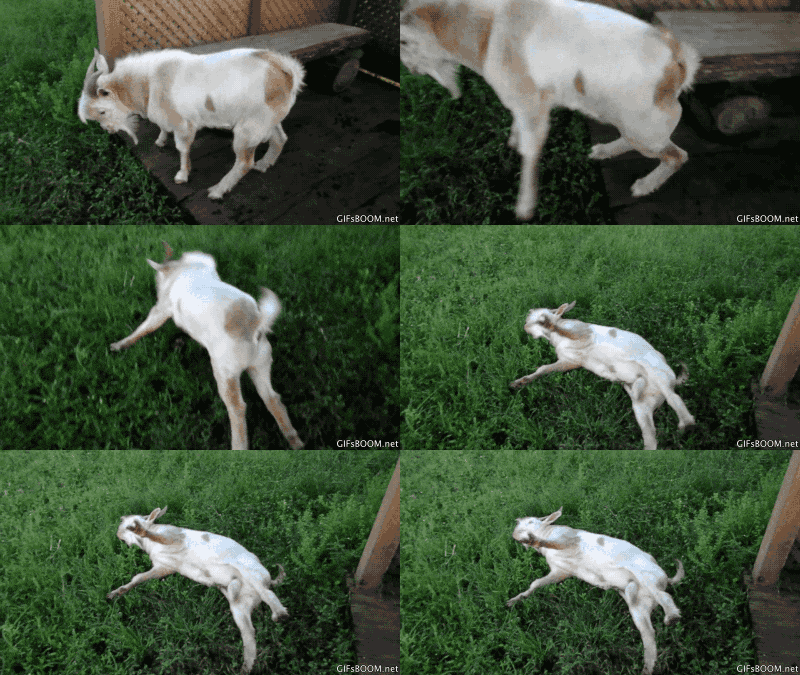
At about mile eight into the climb, I developed cramps. Not your run-of-the-mill tightness, mind you. Instead, I went full-on fainting goat on the ground, next to my bike. Riders came by asking if I was ok, only for me to politely wave with my only functioning limb (my right hand) and say "yep, just a few (about 20 simultaneously) cramps." It was a miserable experience. For the next 4 miles, I could barely walk, let alone bike, but I managed to get to the top, crush a can of Coca-Cola at the neutral aid station, take in some salt, and get back to my wife and crew waiting for me at the bottom of the climb. It took me 2 1/2 hours to make that round trip.
What happened?
At mile 20 of the race, a team of us had set up a crewing station where we could replenish our fuel (carb gel packs and bars) and liquids. I grabbed the liquids, but given the adrenaline of the moment, I forgot the fuel. By the time I hit Columbine, I was hundreds of calories short of my required amount, not to mention the electrolytes needed to help reduce cramping risks. Enter fainting goat mode. I fell out of my routine. I had to "remember" to ask for the fuel. After months of routine, of pancakes, of timing my intake, etc., I had failed to automate the most important part, the race itself.
I'm still not sure how I finished the race, but with some doubling up of carbs and enough internal profanity-laced encouragement to make the drunkest of sailors blush, I made it work, crossing the finish line to my waiting family and friends. It was an overwhelming and emotional experience that I'll never forget.
Conclusion
I hope you enjoyed this silly story about oatmeal, training, and its loose relation to money. Hopefully, it's clear that after trying this crazy race, I am still very much an amateur and have so much to learn. The training and the pursuit truly were fun. The race, even with its challenges, whether I finished or not, was the prize and one of the coolest things I have ever been lucky enough to participate in.
As for saving and investing, I've seen a lot over my three decades in this field. I'm now like the wily race veteran who yells out "the race isn't won here" at the financial equivalent of mile 5 (true race story) of rookies too eager to get ahead in the race of life. Slow and steady leaves us with plenty of fuel when we need it most, hopefully keeping financial cramps at bay.
If not too silly or ridiculous to share, I welcome it going to anyone you feel could benefit from perhaps a different take on finances, unnecessarily high use of poor analogies notwithstanding.
Oh, and if you are curious, Old Stumpy made it to the end without a hitch. Who knows, maybe we'll do it together again in 2027.
As always, thank you for your time.
Brian
Aberle Investment Management LLC is a registered investment adviser. The information presented is for educational purposes only and does not intend to make an offer or solicitation for the sale or purchase of any specific securities, investments, or investment strategies. Investments involve risk and, unless otherwise stated, are not guaranteed. Be sure to consult with a qualified financial adviser or tax professional before implementing any strategy discussed herein. Past performance is not indicative of future returns.